La Coupole Centre D'histoire - The Helfaut Dome


Profile
The Helfaut-Wizernes Dome: From Nazi Bunker to Memory Center
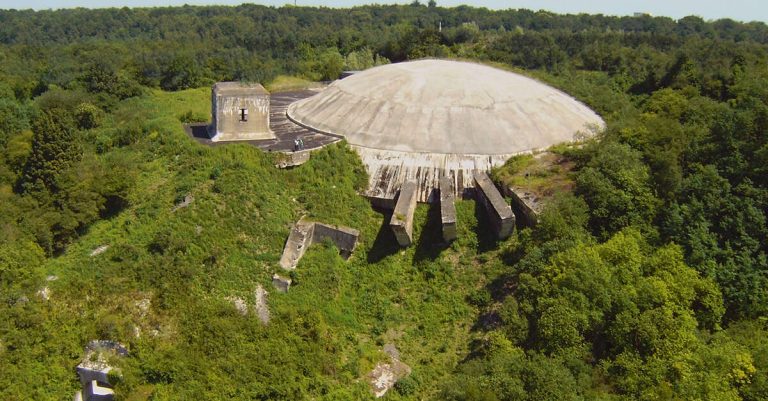
The Helfaut-Wizernes Dome, commonly known as “La Coupole,” is a World War II-era bunker located in Helfaut, near Saint-Omer in northern France. Originally built by Nazi Germany between 1943 and 1944 under codenames Bauvorhaben 21 and Schotterwerk Nordwest, the site was intended as a launch base for V2 rockets targeting London and southern England. Today, it serves as a history and science museum.
Origins and Context
The V2 rocket—history’s first long-range ballistic missile—was developed by Germany as a response to the Luftwaffe’s failure to defeat Britain. Work began in 1936, with the goal of demoralizing the British and forcing them into peace negotiations. Propelled by a mix of methanol and liquid oxygen, the 12.5-ton, 14-meter rocket had a 320 km range.
Germany needed new liquid oxygen sources close to the launch zones. Given the range requirements, northern France, Belgium, and the Netherlands were ideal for launch sites. The German high command debated whether to build large fortified bases or deploy mobile Meillerwagen launchers. Hitler favored massive, permanent installations, inspired by U-boat bunkers, and pushed forward with a bunker at Watten, quickly spotted and bombed by Allied aircraft.
After the Watten site was compromised, the Nazis sought a new location nearby. They settled on a former chalk quarry between Helfaut and Wizernes, conveniently close to rail lines and sufficiently shielded. Planning for this new underground complex began in late 1943, under the supervision of Organisation Todt.
Design and Construction
The Wizernes site was conceived as an underground fortress, with a 71-meter-wide, 55,000-ton concrete dome as its centerpiece. Beneath it, a vast hexagonal preparation chamber and a 7-km network of tunnels were to house rockets, liquid oxygen facilities, workshops, and barracks. Two massive launch tunnels—Gustav and Gretchen—were planned to lead out to the quarry, each ending in rocket launch pads aimed at London.
To bring supplies in, engineers designed a rail loop called “Ida,” allowing trains to enter the site without reversing. Unloaded V2 rockets would be moved through tunnels named Mathilde, Hugo, and Sophie for storage and assembly. The core preparation hall beneath the dome was never completed but was envisioned to be 33 meters tall with ten intermediate levels. The dome was designed by engineer Werner Flos and built first above ground, with excavation beneath it afterward—a strategy to protect the structure from Allied air raids.
More than a million tons of concrete were to be used. Up to 1,400 workers—mostly German engineers, conscripted French laborers, and Soviet POWs—worked under constant threat of bombing. Despite camouflage and heavy fortifications, Allied intelligence identified the site as a strategic threat.
Allied Bombing and the Collapse of the Project
The Allies began surveillance of the site in August 1943, and it was added to the Crossbow bombing target list in early 1944. From March to August that year, over 800 bombers dropped more than 4,200 tons of explosives on the area. Despite the intensity, the concrete dome was nearly impervious, sustaining only minor damage.
However, in June and July 1944, British bombers deployed 5,443 kg “Tallboy” bombs designed to penetrate deep underground. One Tallboy cratered the side of the quarry, burying the Gustav and Gretchen tunnels. The dome itself remained intact, but landslides and structural instability rendered the site inoperable.
Recognizing the futility of further construction, the Wehrmacht halted work in July 1944. Hitler subsequently ordered the conversion of the facility into a liquid oxygen plant, but this too was abandoned after the D-Day landings. The Allies captured the site in early September 1944.
Post-War Investigations and Abandonment
Upon Allied occupation, British engineer Colonel Terence Sanders led a mission to assess the purpose of the site. He concluded that it was designed for vertical handling and launch of long-range rockets, possibly even larger than the V2. Though never used for its intended purpose, the scale and design left no doubt about its offensive potential.
After the war, the site was returned to its private owner and abandoned. The tunnels were blocked but not destroyed. Locals explored parts of the complex, and some sections were used as firing ranges by French police. The main dome remained untouched for decades, standing as a concrete relic of Hitler’s failed missile program.
Transformation into a Museum: La Coupole
In the 1980s, local authorities began developing the site as a historical attraction. In 1986, the Lille Regional Council granted 10 million francs for initial restoration. Historian Yves Le Maner led the project, with structural work and excavation completed in the early 1990s.
The museum opened in May 1997, with exhibits focused on three main themes:
-
The Nazi occupation of northern France
-
The V2 missile program
-
The post-war history of space exploration
Visitors enter through the restored Ida tunnel and explore wartime artifacts in adjacent galleries. A central elevator takes them under the dome, where the main exhibition includes a restored V2 rocket (on loan from the Smithsonian) and a V1 flying bomb (from the London Science Museum). Exhibits are multilingual and combine audiovisual storytelling with authentic relics.
A Memorial and Educational Center
In addition to military history, La Coupole is home to a memorial for the 8,000 residents of Nord–Pas-de-Calais who were executed or deported during the war—555 executed, 6,704 deported, 688 Jews, and 166 Roma. Portraits of victims line a dedicated gallery, with new images added regularly as descendants contribute information.
In 2012, a €6 million planetarium and education center was opened on-site, supported by local and European institutions. La Coupole has since expanded its educational offerings, welcoming around 120,000 visitors annually.
It also administers the nearby Mimoyecques Fortress, once a V3 supergun site.
Legacy of La Coupole
Today, the dome stands as both a technological marvel and a sobering reminder of the destructive ambition of the Third Reich. Though it never launched a single rocket, its very existence shaped the course of the war and the post-war arms race. As a museum, La Coupole bridges war history with space exploration, connecting the V2’s legacy to modern rocketry and reminding visitors of the human cost behind technological progress.


Map
Sorry, no records were found. Please adjust your search criteria and try again.
Sorry, unable to load the Maps API.