Diefenbunker: Canada's Cold War Bunker


Profile
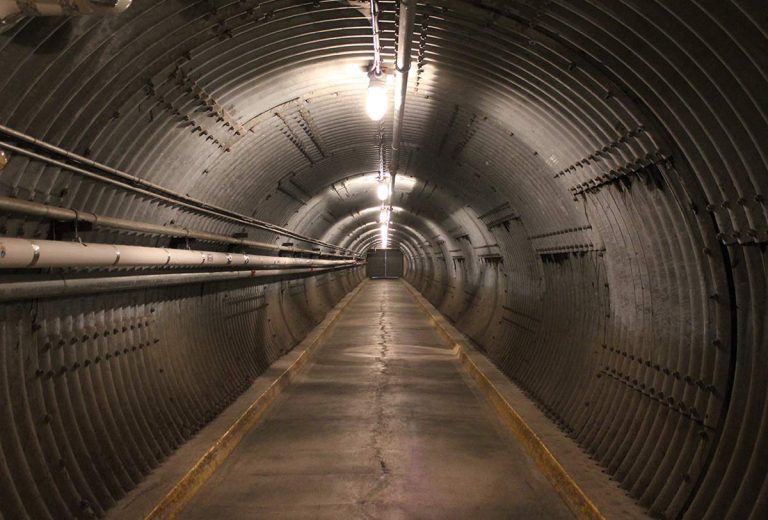
The Diefenbunker, formerly known as Canadian Forces Station (CFS) Carp, is a four-story underground nuclear shelter in Carp, Ontario, about 30 km west of Ottawa. Built between 1957 and 1961 during the Cold War, it was designed as the Central Emergency Government Headquarters to ensure government continuity in case of a nuclear attack. The facility was decommissioned in 1994.
Recognized as Canada’s most significant Cold War site, the Diefenbunker represents the era’s engineering achievements and nuclear deterrence strategy. Designed to withstand all but a direct nuclear hit, the shelter could support 565 people for a month with stockpiles of food, fuel, and water. It also housed an emergency broadcasting studio and a vault for the Bank of Canada’s gold reserves.
During the Cold War, nearly 50 similar bunkers were planned across Canada, but the Carp site was the largest. Originally intended for a different location, construction moved to an abandoned gravel pit due to water issues. Completed in 1962, it was reinforced with 32,000 tonnes of concrete and 5,000 tonnes of steel, making it resistant to a 5-megaton blast from 1.8 km away. However, advancements in bunker-buster bombs later revealed vulnerabilities.
CFS Carp operated until 1994 under the Royal Canadian Corps of Signals. Supporting facilities, including a transmitter site near Perth and receiving stations in Almonte and Dunrobin, were part of its communications network.
After decommissioning, local interest led to its transformation into a museum in 1998. The Diefenbunker: Canada’s Cold War Museum preserves its history with restored rooms such as the Prime Minister’s suite, the Emergency Government Situation Centre, and the CBC studio. Of its 358 rooms, many now serve as Cold War exhibits.
Since its opening, the museum has grown significantly. Initially run by volunteers, it now has staff and welcomes thousands of visitors annually. By 2017, attendance reached 88,000, partly due to attractions like its escape room, one of the largest in the world. The museum aims to educate the public on Cold War history while preserving this national historic site.


Map
Sorry, no records were found. Please adjust your search criteria and try again.
Sorry, unable to load the Maps API.