Central Government War Headquarters, aka Burlington Bunker
Profile
The Central Government War Headquarters (CGWHQ) is a 35-acre underground complex located 120 feet below the surface in Corsham, Wiltshire, UK. Built during the Cold War, it was designed to serve as the United Kingdom’s emergency government headquarters, providing an alternative seat of power in the event of a nuclear conflict or war with the Soviet Union. The site is located in a former Bath stone quarry known as Spring Quarry, which was acquired in 1940 for use as an underground engine factory during the Second World War. The war headquarters itself was commissioned in 1955, following approval from Prime Minister Anthony Eden. However, it soon became obsolete due to the development of intercontinental ballistic missiles capable of targeting the site, and other contingency plans, such as the PYTHON plan, were formulated. Despite this, the complex remained operational for over 30 years, continuing to play a role in the UK’s war plans.
The complex was referred to by several code names, including “Stockwell,” “Subterfuge,” “Burlington,” “Turnstile,” “Chanticleer,” “Peripheral,” and “Site 3.” It was also nicknamed “Hawthorn” by journalist Duncan Campbell, who revealed its existence in his 1982 book War Plan UK.
Features The CGWHQ site stretches over 1 kilometer (3,300 feet) in length and includes more than 60 miles (97 km) of roads. The complex was designed to accommodate the Prime Minister, the entire Cabinet Office, other key civil servants, and support staff. With blast-proof construction and complete self-sufficiency, the site could house up to 4,000 people for up to three months without outside assistance. It featured a range of facilities necessary for survival, including hospitals, canteens, kitchens, laundries, storage rooms for supplies, accommodation areas, and offices.
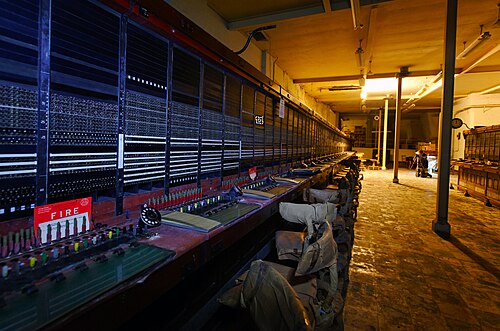
An underground lake and treatment plant could provide drinking water, and twelve fuel tanks were available to power the four generators in the underground power station for up to three months. The air quality within the complex could be maintained at a constant humidity and temperature of approximately 20°C (68°F). Additionally, the site was home to the second-largest telephone exchange in Britain, a BBC studio where the Prime Minister could address the nation, and an internal Lamson Tube system to relay messages throughout the complex using compressed air.
To maintain secrecy, the arrival of personnel to the site was carefully planned. Essential workers were instructed to assemble at an outlying location, Warminster, where they would be transported by a fleet of army lorries to the CGWHQ site. Senior officials from Whitehall were similarly instructed to gather at Kensington (Olympia) station in West London, unaware of their destination. From there, they would be transported by special train to Warminster and then by bus to the Warminster Infantry Training Centre. Once there, they would be broken into small groups for the final leg of the journey, a 23-mile lorry trip to Corsham. The Prime Minister was to remain at Downing Street until the last moment before being flown to Corsham by helicopter.
Map
Sorry, no records were found. Please adjust your search criteria and try again.
Sorry, unable to load the Maps API.